


New guidance shows how employers can better protect workers as climate-driven health risks accelerate.



As extreme weather continues to intensify, new guidance for health professionals can also help employers keep their workers safe and their operations running.
At a National Commission on Climate and Workforce Health event on Dec. 17, 2025, members heard from two of the authors behind the recent American College of Occupational and Environmental Medicine (ACOEM) guidance statement:
The guidance statement, "Harnessing Occupational and Environmental Medicine Expertise to Transform Medical Care," calls on medical professionals to leverage occupational and environmental medicine (OEM) tactics in climate health efforts, including education and risk assessment. The recommendations also offer employers practical steps to shield workers from climate-driven health threats.
The researchers emphasized that climate change creates a cascade of health threats:
People often face greater climate hazards on the job than anywhere else, due to higher intensities and longer durations of exposure.
"Think about firefighters going into fight fires, or construction workers working throughout the day in intense heat," Dr. Nabeel explained. "They are more exposed, they have significant amounts of exposure over time, and then there's an interaction of exposures that comes with it."
Climate-driven risks extend across industries and settings:
For many workers, the risks don't end when they clock out. Dr. Nabeel noted that workers often live in apartments without air conditioning, in flood-prone areas, or in communities with poor air quality. These compounding exposures make some workers doubly vulnerable to climate-driven health effects.
One of the most practical tools the researchers pointed to is the hierarchy of controls, a framework that ranks protective measures from most to least effective. The most effective interventions are those that eliminate or reduce hazards at the source, rather than relying on individual worker behavior or protective equipment.
Using wildfire smoke as an example, the researchers explained how employers can prioritize interventions:
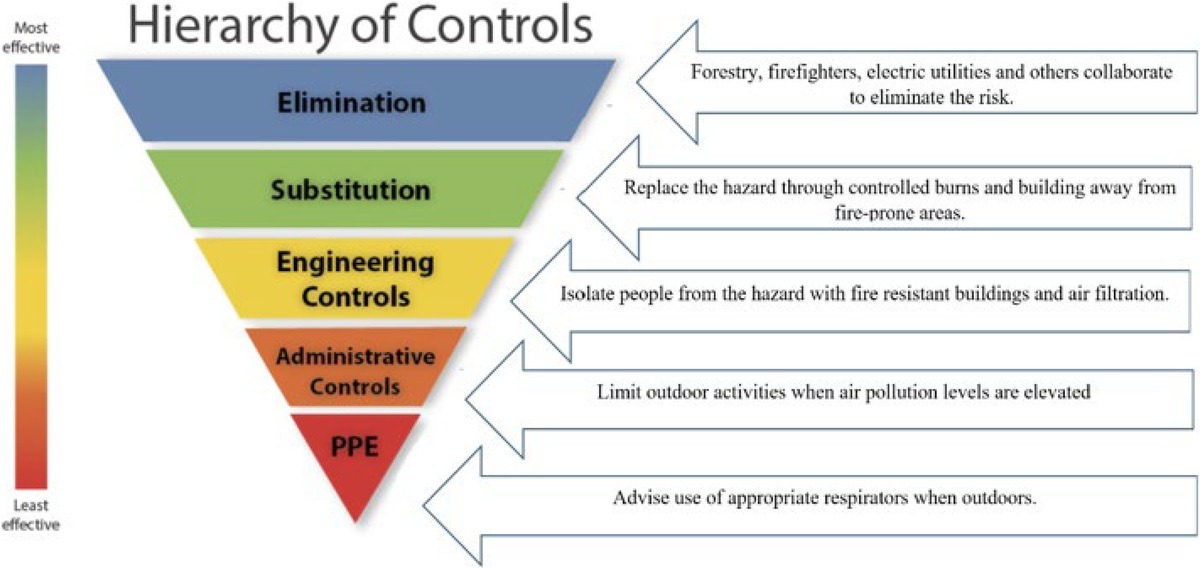
"Personal protective equipment such as respirators certainly can be used to protect oneself from wildfire smoke, but it is the least effective, most uncomfortable approach to dealing with this," Dr. McLellan said.
Based on the new guidance and discussion with the researchers, employers can take several practical steps:
1. Know your location-specific risks. Climate threats vary by geography. Heat waves, flooding, wildfire smoke, and vector-borne disease risks differ by region and by season. Use tools like the Climate Vulnerability Index and Climate Health Cost Forecaster to understand what risks your workforce faces and how specific roles or individuals may be more heavily affected.
2. Assess both outdoor and indoor exposures. Don't assume indoor workers are protected. Warehouses, manufacturing facilities, and other indoor settings can be dangerous, especially when cooling systems fail.
3. Build your hierarchy of controls, starting from the top. Once you understand the hazards and specific risks your workforce faces, "you can begin to apply that hierarchy of controls, hopefully starting at the top of that pyramid rather than the bottom," Dr. McLellan said. Prioritize engineering and administrative controls before defaulting to personal protective equipment.
4. Partner with occupational medicine professionals. OEM clinicians bring expertise in risk assessment, hazard identification, and the hierarchy of controls. They can help employers develop comprehensive climate health strategies and support workers with chronic conditions that make them more vulnerable to climate stressors.
5. Listen to your workers. Employees often have direct insight into the climate-related challenges they face on the job. Encourage workers to voice the risks and concerns they're experiencing; their perspective is essential to identify gaps and build effective protections.
6. Address mental health. Climate-related health impacts extend beyond physical symptoms. Consider how extreme weather events, repeated disasters, and climate anxiety may affect your workforce's mental health and ensure your employee assistance program and benefits offerings can respond.
7. Plan proactively for disasters, before they hit. Disasters create complex, rapidly changing conditions for workers: unfamiliar environments, shifting environmental exposures, limited access to food, shelter, and medication. Dr. Nabeel emphasized that employers should "look at the bigger picture" and anticipate these challenges in advance, especially for workers who may be essential in disaster zones or have chronic health conditions that require consistent access to medication. Building these plans now, rather than in the chaos of a response, can prevent injuries and protect your most vulnerable workers.
Workers face elevated climate health risks, and occupational medicine professionals have tools and expertise that can help. The researchers emphasized that these challenges require collaboration between medical professionals, employers, public health agencies, and community organizations. The time to build partnerships and develop comprehensive climate health strategies is now.

The National Commission on Climate and Workforce Health is a nationwide effort to protect workers from the health risks posed by extreme weather.
The Commission was created by the Health Action Alliance in partnership with Mercer and with strategic input from the CDC Foundation. Additional support for the initiative is being provided by The Hartford.
Want to help your company adapt to today’s climate conditions and invest in human and business resilience? Sign up for our monthly newsletter to stay up to date on our latest events, resources, and recommendations.
If you're interested in learning more about this programming and getting involved in our work, please reach out to climate@healthaction.org.

The National Commission on Climate and Workforce Health is a group of business, health, and climate leaders who share a mission to protect workers from the health risks posed by extreme weather.
The Commission was created by the Health Action Alliance in partnership with Mercer and with strategic input from the CDC Foundation. Additional support for the initiative is being provided by Elevance Health and The Hartford. Learn more at ClimateHealthCommission.org.

Sign up for our newsletter to keep updated on HAA’s latest initiatives, insights and recommendations, and be first to receive new resources and event invitations.
Sign up


.svg)


