


Cathalene Teahan, President of the Georgia AIDS Coalition and Senior Public Affairs Consultant at Capitol Strategy, discusses four decades of frontline nursing, health policy advocacy, and why the private sector holds the key to mobilizing the political will needed to end HIV.
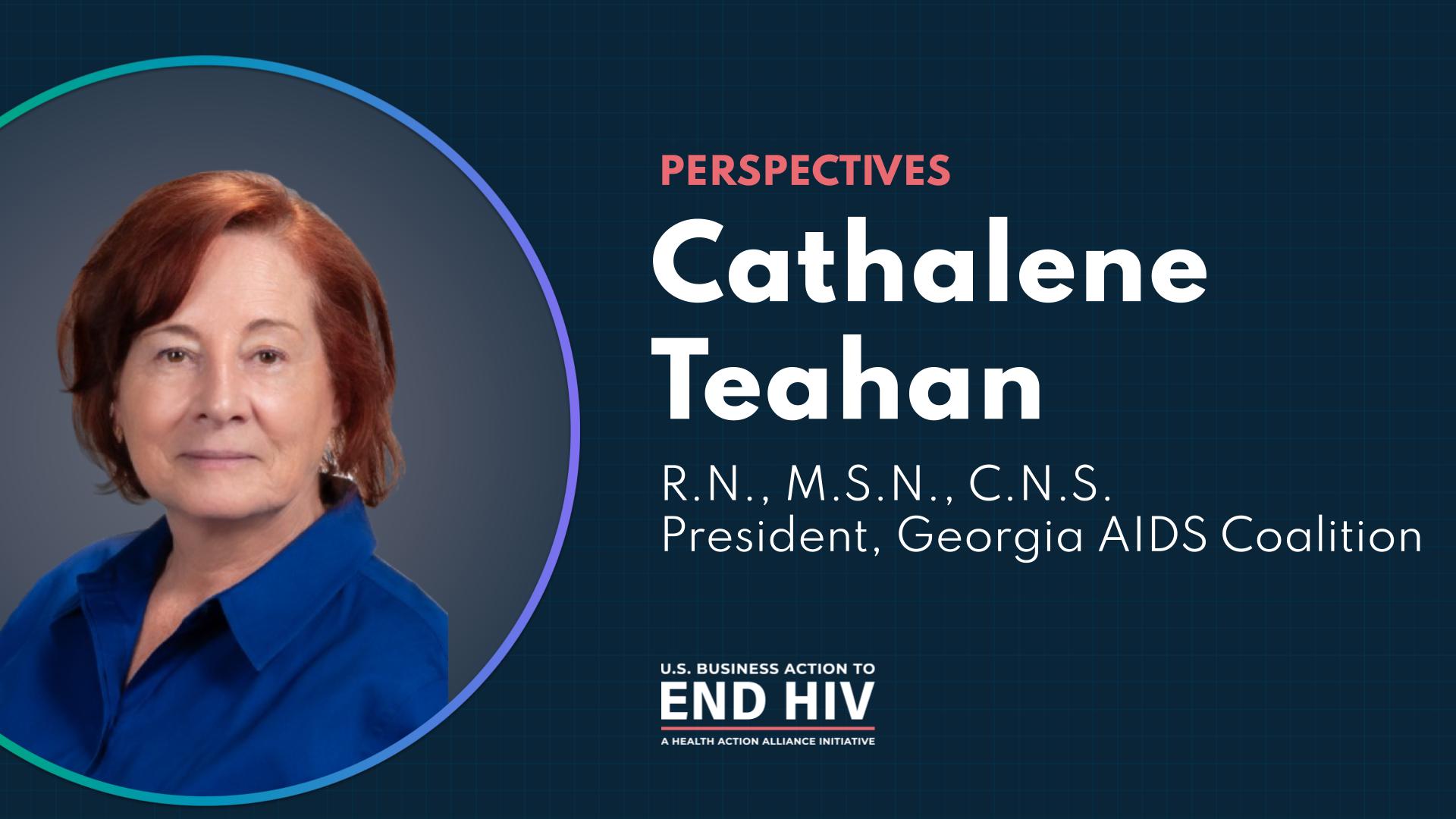



“Perspectives” is a series highlighting advisors, public health leaders, and advocates whose work informs systemic solutions, advances evidence-based policy, and drives meaningful health outcomes across communities.
This month, we spotlight Cathalene Teahan, R.N., M.S.N., C.N.S., President of the Georgia AIDS Coalition and Senior Public Affairs Consultant at Capitol Strategy.
Cathalene Teahan is a veteran healthcare lobbyist, patient advocate, clinical nurse specialist, and state health policy strategist with more than 40 years of experience bridging clinical practice, grassroots community organizing, and legislative advocacy. She began her work on the front lines of the HIV epidemic while completing her master’s degree in nursing at the University of Hawaii, where she served as a Founding Member, Executive Director, and Board President of the Life Foundation and coordinated CDC-funded research examining cross-ethnic attitudes toward AIDS.
Upon returning to the mainland in the late 1980s, Teahan helped develop curriculum for the AIDS Education and Training Center at Morehouse School of Medicine in Atlanta and taught nursing at Morris Brown College and Georgia State University. She transitioned into policy in direct response to the epidemic, developing deep expertise in legislative strategy, healthcare access, and state health budgeting.
Over the past four decades, Teahan has partnered across the public and private sectors to pass landmark public health legislation in Georgia. Her work includes measures to eliminate perinatal HIV and congenital syphilis, modernize testing and criminalization statutes, authorize Syringe Services Programs, Expedited Partner Therapy, standby guardianship, and pharmacy-initiated PrEP and PEP, as well as securing dedicated state funding for ADAP and PrEP. She also actively advises on the federal HIV portfolio. Today, she serves as President of the Georgia AIDS Coalition and Senior Public Affairs Consultant with Capitol Strategy, contributing to state and national leadership bodies dedicated to ending the epidemic and protecting patient care.
My dedication began at the very onset of the epidemic, long before we understood what the virus was or how it was transmitted. In those early years, intense fear gripped both impacted communities and the public — all too often, that fear turned into anger, stigma, and violence. As a nurse, my first responsibility was caring for those afflicted by the disease: providing compassionate frontline care, supporting families through unimaginable uncertainty, and replacing panic with accurate, evidence-based education.
Over the decades, research has radically transformed what is possible, giving us treatments to suppress the virus and powerful prevention tools while we continue the work toward a vaccine and a cure. What keeps me dedicated today is ensuring that the next generation understands this history, learns from how far we have come, and carries the momentum forward. We have come too far to ever give up.
Early in the epidemic in Hawaii, I co-founded The Life Foundation alongside Dr. David McEwen and Jack Law, a prominent Hawaii business leader. That partnership showed me early on that the private sector brings a distinct operational perspective, strategic discipline, and organizational framework to public health initiatives that otherwise would not exist.
Ending the HIV epidemic is no longer just a scientific challenge—it is a matter of political will. Coalition members and the broader business community possess the unique leverage, resources, and civic influence required to turn public health priorities into actionable policy and bring this epidemic to an end.
We are at a decisive inflection point where ending the HIV epidemic is entirely within reach. While science has delivered the clinical tools needed to achieve viral suppression and halt transmission, medical breakthroughs alone cannot cross the finish line without systemic implementation.
This is where the role of business is critical. When business leaders engage, they bridge the gap between scientific capability and structural policy change. By deploying their corporate voice, resources, and civic standing, employers can dismantle access barriers and help drive the sustained political momentum required to end HIV for good.
Partner directly with organizations already doing the work on the ground in your community. Businesses can get involved in many tangible ways—whether by sponsoring or participating in local fundraisers, hosting community town halls, or lending corporate platforms to amplify public health education.
Just as importantly, businesses can align with groups leading policy and grassroots advocacy. By using your corporate voice to support initiatives that protect and expand access to testing, treatment, and prevention, companies can help break down structural barriers and ensure vital healthcare resources reach the people who need them most.
We have seen tremendous progress, but we cannot afford complacency. Sustained advocacy and sound policy are what translate clinical breakthroughs into real-world access and saved lives. With persistent commitment across both the public and private sectors, ending this epidemic is completely within our reach and power.
Sign up for our newsletter to keep updated on HAA’s latest initiatives, insights and recommendations, and be first to receive new resources and event invitations.
Sign up


.svg)


