


“Perspectives” is a series that highlights our advisors who are leaders in the HIV field and provide guidance to the Coalition, ensuring that our priorities are informed by the latest scientific research and best practices.



“Perspectives” is a series highlighting advisors, public health leaders, and advocates whose work informs systemic solutions, advances evidence-based policy, and drives meaningful health outcomes across communities.
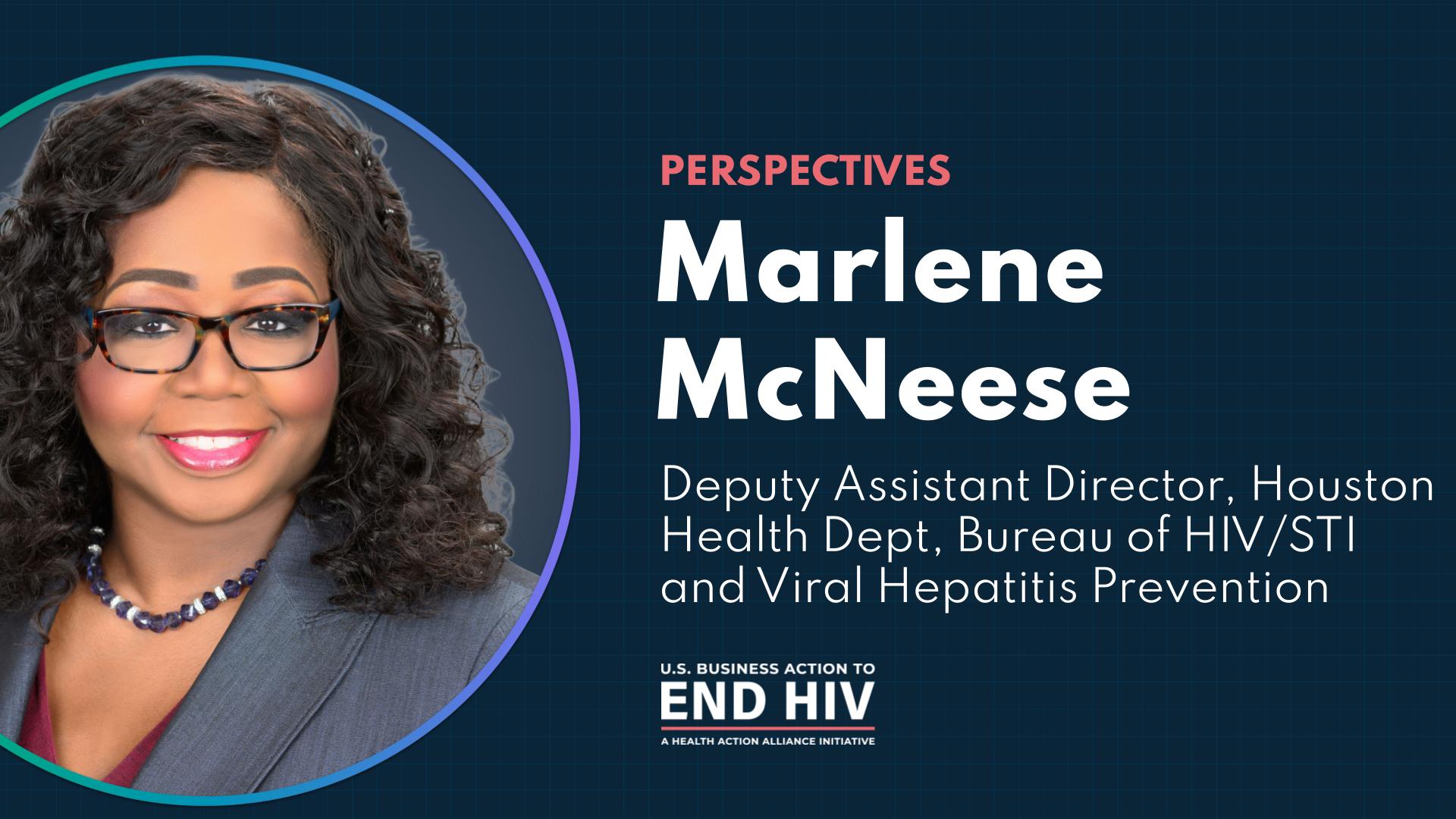
This month, we spotlight Marlene McNeese, Deputy Assistant Director, Houston Health Department, Bureau of HIV/STI and Viral Hepatitis Prevention and HIV Leadership Advisory Council Member.
I have spent more than two decades at the Houston Health Department, where I currently serve as Deputy Assistant Director for the Bureau of HIV/STI and Viral Hepatitis Prevention. But my commitment to HIV extends well beyond my title. Over the years, I have had the privilege of working alongside people living with HIV, community organizations, healthcare providers, advocates, policymakers, and national leaders to strengthen HIV prevention and care.
My leadership has also included serving as Chair of the Houston Area Ryan White Planning Council, Co-Chair of the Houston HIV Prevention Community Planning Group, Board Chair of NASTAD, and Co-Chair of the Presidential Advisory Council on HIV/AIDS.
Those experiences have allowed me to see HIV from many perspectives, local and national, community and government, policy and practice. And through all of them, one principle has remained constant for me: the people most impacted by HIV must remain at the center of the response.
My journey into HIV work began with people, not programs, not policies, but people. More specifically, my grandmother. In the early 1980s, when much about HIV was not known to general medicine or Black communities. Our family watched her rapid health decline after a blood transfusion. She was forbidden from having family contact, or direct human touch in her final days, as doctors began to don protective gear and quarantine her room. Our family knew nothing about what was going on at the time, and having since learned the connection and complication from HIV, I have dedicated my life’s work to ensuring other Black families don’t have to experience those same lack of information and trauma. This work for me is about people, justice, dignity, and whether our systems are willing to value every life equally.
That is what keeps me committed. I believe where you live, who you love, how much money you make, your race, your gender identity, or your HIV status should never determine whether you have the opportunity to live a healthy and fulfilling life.
For me, ending HIV is both a public health responsibility and a social justice commitment
I would like businesses to recognize that they have much more influence on the HIV response than they may realize. Businesses employ people, influence workplace culture, invest in communities, communicate with millions of consumers, and have tremendous ability to normalize conversations that public health sometimes struggles to reach.
I would encourage coalition members to use that influence intentionally. Make sure employee health benefits support comprehensive HIV prevention, testing, treatment, and PrEP access. Create workplaces where people living with HIV can be open about their health without fear of stigma or discrimination. Use corporate platforms to normalize HIV testing and prevention. Invest in community-based organizations already doing trusted work in communities disproportionately affected by HIV. Equally important is to not simply ask communities what they need, but build sustained partnerships with them and invest in their leadership.
Ending HIV cannot belong exclusively to government, public health departments, or healthcare providers. Business has resources, reach, creativity, influence, and convening power that can accelerate our collective impact.
We are at an extraordinary and complicated moment in the HIV response. Scientifically, we have more tools than ever before. We know treatment can allow people with HIV to live long, healthy lives. We know that a person who maintains an undetectable viral load does not sexually transmit HIV, Undetectable equals Untransmittable, or U=U. We have highly effective PrEP options, and prevention science continues to advance.
At the same time, we continue to confront stigma, misinformation, workforce challenges, funding uncertainty, and persistent inequities in who benefits from those advances. That is why business leadership is particularly important right now. Businesses can help provide continuity when other systems are experiencing uncertainty. They can amplify accurate information, protect inclusive workplaces, strengthen access through employee benefits, invest locally, and use their influence to keep HIV visible as a health and social justice priority. This is a moment for businesses to decide whether they simply support the goal of ending HIV, or whether they are prepared to become active partners in achieving it
Start locally. Identify one trusted HIV community-based organization in the community where your employees live and work, sit down with its leadership, and ask a simple question, “What is one thing our company could do this year that would make your work easier or your impact greater?” Then listen and act.
The answer might be funding. But it could also be communications expertise, technology, meeting space, transportation assistance, volunteers, workforce development, data expertise, legal assistance, or access to networks the organization otherwise could not reach. Companies do not always have to create new programs. Sometimes the most powerful thing they can do is strengthen organizations that communities already know and trust. Start with one relationship. Make it meaningful and stay long enough to build trust.
I would leave Coalition members with this; please don't underestimate your power to help change the trajectory of this epidemic. Every major chapter of the HIV response required people and institutions to do something that once seemed difficult, to speak openly about HIV, confront stigma, challenge inequitable systems, invest in science, and stand alongside communities demanding change. We have reached another one of those moments.
Ending HIV will require science, certainly. But the science alone will not get us there. It will require trust, equity, courage, sustained investment, and partnerships that extend far beyond traditional public health. Every coalition has something valuable to contribute to the work ahead. Maybe it is your workforce. Maybe it is your platform. Maybe it is your purchasing power, technology, communications expertise, relationships, or resources. Bring what you have and then stay with us. Because ending HIV is possible. But only if we decide that it is everyone's business.
Sign up for our newsletter to keep updated on HAA’s latest initiatives, insights and recommendations, and be first to receive new resources and event invitations.
Sign up


.svg)


