


Newsletter from U.S. Business Action to End HIV, providing the latest actions from the coalition, together with other important news.
.png)


Editorial Note: You can stay informed and receive our monthly Action Report newsletter directly to your inbox by joining the mailing list.

This month brought real momentum — star power on Capitol Hill, a landmark study on AI and PrEP uptake, awards for bipartisan Congressional champions, and a direct letter to the Administration making the business community's case for FY2027 HIV funding. Our members and coalition showed up in force, and there's a lot to share. Welcome to the March 2026 Action Report!
.png)
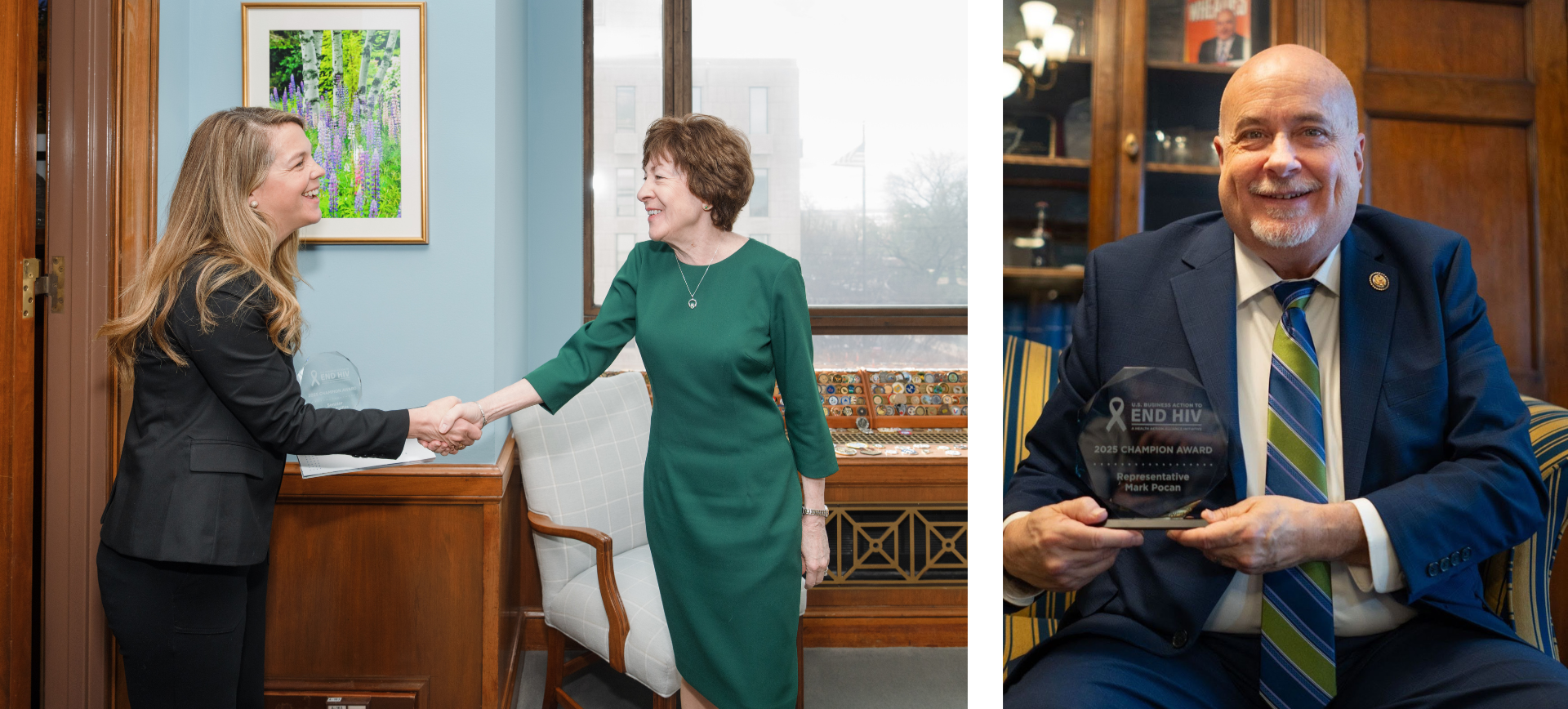
Last week, a delegation from U.S. Business Action to End HIV traveled to Capitol Hill to present our Inaugural Champion Awards. Four members of Congress were recognized by the business community for their commitment to HIV prevention and treatment funding, including Senator Susan Collins (R-ME), Senator Tammy Baldwin (D-WI), Senator Bill Cassidy (R-LA), and Representative Mark Pocan (D-WI).
At a moment when bipartisan agreement feels rare, it felt especially meaningful to honor leaders from both sides of the aisle united by their commitment to protecting federal HIV programs. We were proud to be joined on the Hill by Coalition Leaders: Match Group, Merck, MISTR, and ViiV Healthcare.
.jpg)
With FY2027 budget negotiations underway, the Coalition took action. We sent a letter to President Trump, informed by our Government Relations & Public Affairs Cohort, to acknowledge his signing of the FY2026 spending bill and make the case for continued federal investment in HIV prevention and treatment.
The letter was delivered directly to key leaders across the administration, including the White House, OMB, CMS, CDC, NIH, and HHS advisors — ensuring that the business community's voice reaches the officials who will shape what comes next.
.png)
AIDS Walks are happening in cities across the country this spring and fall, and they're one of the easiest, most visible ways your company can show up for the HIV response in your own backyard.
Whether you become a corporate sponsor, build a company team, or encourage employees to register as individual walkers, participating in a local AIDS Walk delivers real value: corporate visibility, leadership opportunities, and community networking, alongside meaningful employee engagement and retention.
Most importantly, it makes a tangible difference locally by supporting organizations that provide HIV services to the community. Find a walk near your headquarters or employees and take action this year.
April 18: Walk to End HIV Houston
April 18: Walk for AIDS Belmont, NC
April 25: AIDS Walk Kansas City
May 2: AIDS Run/Walk for Life Rhode Island
May 3: New Jersey AIDS Walk
May 9: Maine AIDS Walk
May 17: AIDS Walk New York
May 30: AIDS Walk Charlotte
Sept. 26: AIDS Walk Atlanta & Music Festival
Oct. 18: AIDS Walk LA
This newsletter is made possible with additional support from

“Perspectives” is a new series that highlights members of our advisors who are leaders in the HIV field and provide guidance to the Coalition, ensuring that the latest scientific research and best practices inform our priorities.

I am a community health scholar, Gen Z public health leader, and the Chair of the national HIV Leadership Advisory Council for the U.S. Business Action to End HIV. I also serve as Vice President of Community Health & Partnerships at the Southern Legal Center for Youth, where I lead the Southern Kiki Leaders Collective, a youth-centered HIV prevention and leadership program working with LGBTQ+ young adults across the Southern United States.
My work bridges community leadership, prevention advocacy, and cross-sector partnerships to expand access to HIV prevention tools, culturally relevant engagement, and youth leadership development.
I hope to see companies continue expanding their role by investing directly in community-led solutions and prevention innovation. In my work across the country, I see firsthand how youth-led and developed programs can drive prevention engagement. When businesses align with organizations doing this work on the ground and use their platforms to advance awareness and reduce stigma, they become powerful catalysts for accelerating progress toward ending the epidemic.
Build a meaningful partnership with a local community-based organization. Many grassroots organizations in the community are leading prevention education, testing, and peer-led outreach initiatives, but often operate with limited capacity. Supporting these organizations with funding is important, but so is intentionally and strategically partnering through employee engagement or volunteer networks.
.png)
Two owners of a pharmaceutical wholesaler were sentenced to a combined 38 years in prison for running a nationwide scheme that diverted black-market HIV medications into the legitimate supply chain, endangering patients and defrauding insurers. Their operation led to contaminated and mislabeled drugs reaching pharmacies — causing serious harm, including a patient losing consciousness — and resulted in over $21 million in forfeitures. (U.S. Department of Justice)
Researchers at Yale discovered that HIV produces a circular RNA, dubbed “circHIV,” that enhances the virus’s ability to activate its genes and replicate, revealing a previously unknown mechanism behind its persistence. The finding, published in Nature Microbiology, points to circHIV as a potential new target for future HIV therapies. (Yale News)
NIH and the acting CDC Director, Dr. Jay Bhattacharya, told Congress that he is optimistic that the United States will be able to domestically eradicate HIV by 2030, driven by NIH advances. (Washington Examiner)
.png)
The Health Action Alliance is solely responsible for the content of this page and maintains full editorial control of its resources.
U.S. Business Action to End HIV was founded in 2022 by the Health Action Alliance, with support from ViiV Healthcare, to mobilize a growing coalition of private sector partners committed to filling gaps and accelerating progress to help end HIV in the U.S. by 2030.
The Health Action Alliance is a unique collaboration between leading business, communications, and public health organizations to help employers navigate evolving health challenges, improve the health of workers, and engage with public health partners to build stronger, healthier communities. Founded in 2021 by the Ad Council, Business Roundtable, CDC Foundation, the de Beaumont Foundation, and the Robert Wood Johnson Foundation, HAA's network now includes more than 11,000 employers nationwide, reaching a quarter of U.S. workers.

Sign up for our newsletter to keep updated on HAA’s latest initiatives, insights and recommendations, and be first to receive new resources and event invitations.
Sign up


.svg)


