


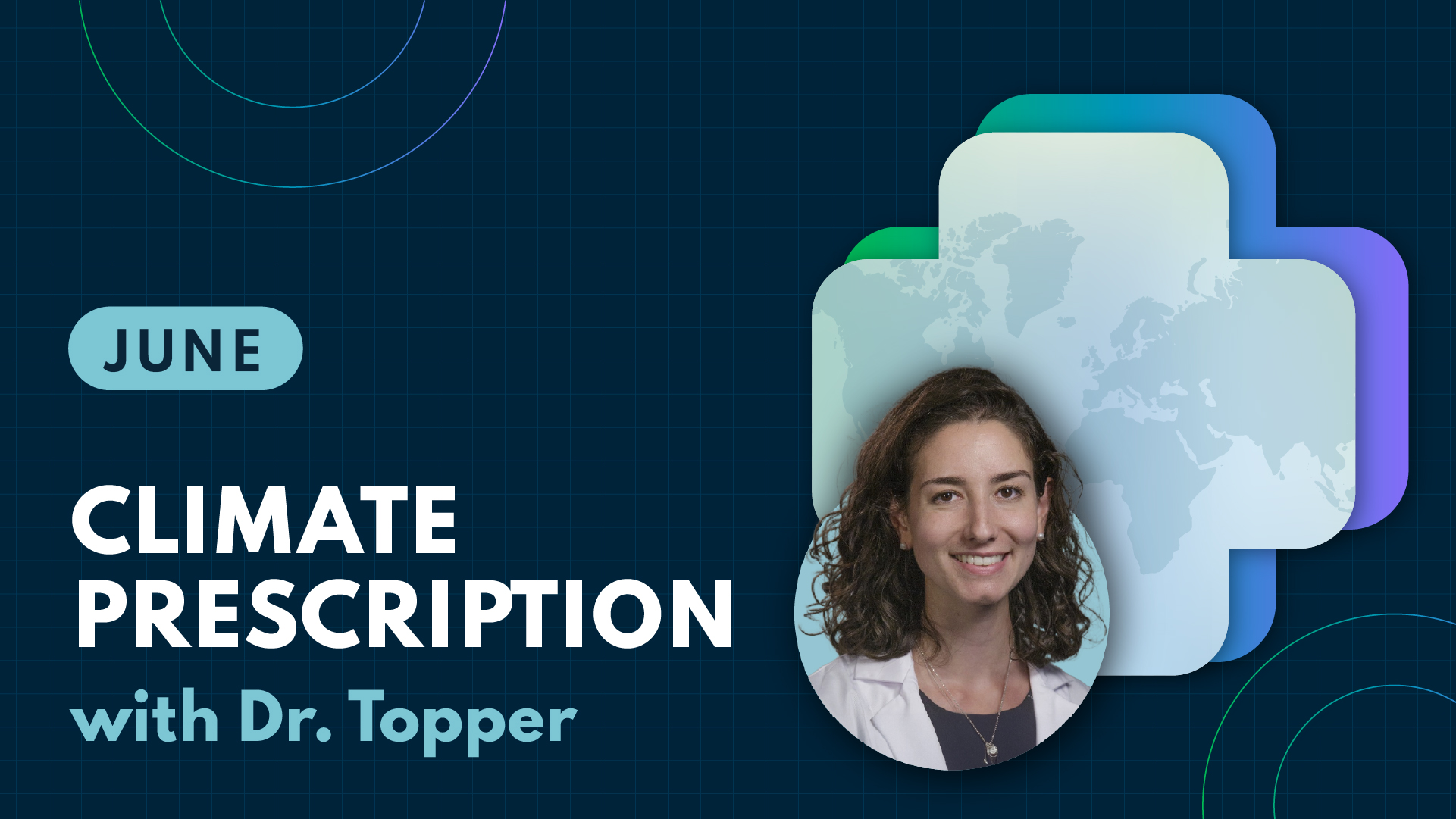
Dr. Leah Topper, family medicine physician and climate fellow, shares what extreme weather looks like from the exam room, and what employers can do about it.


By Shreya Agrawal
For the past year, Dr. Leah Topper has held a job description that doesn't fit neatly on a business card: family medicine physician by training, climate and health advocate by conviction, and now, education, and, in her own words, a "highly trained professional volunteer."
As a fellow with the University of Colorado School of Medicine’s Climate & Health program, she partnered with the Health Action Alliance, translating what she sees in the exam room into guidance employers can use to champion workforce resilience in the face of extreme weather. Her monthly column for HAA, Climate Prescription, covers extreme heat, vector-borne disease, winter storms, mental health, and the quieter health risks that never show up in a forecast.
Before her fellowship wraps up, we sat down with Leah to talk about how she ended up here, what climate change really looks like from a family doctor's chair, and what she wants employers to understand about protecting the people who work for them.

I'm a family medicine physician, and I live in Durham, North Carolina. I've spent most of my life in the Southeast. I grew up mostly in Georgia, went to college in Texas, came back to Georgia for medical school, and then moved to North Carolina for residency, where I've been since I graduated last year. This year, I'm a fellow through the University of Colorado School of Medicine’s Climate & Health program, partnered with the Health Action Alliance.
There are five fellows. We're all physicians, but in different specialties, family medicine, emergency medicine, pediatrics, and a few others, and we commit about half our working hours to the fellowship. I like to call us “professional volunteers” — highly trained professionals placed with nonprofits and other organizations where we can lend our expertise as healthcare professionals who also care about how climate and health connect.
So my week is split. I'm in the clinic about half the time, and the rest is asynchronous project work for my placements, plus meetings. We also have didactic sessions, where the fellows learn together about different topics in climate and health.
My story probably starts in college. I went in not knowing what I wanted to do, only that I liked a lot of different things, and I ended up with a degree in ecology and evolutionary biology. I was doing a lot of work in environmental spaces and thinking pretty broadly about the world. Ultimately, I decided that I didn't love being alone in laboratories and that it wasn't the right fit for me. What I did love was working with people and doing science in relation to people. So after college, I decided to go to medical school.
The turning point was almost an accident. I was looking for a summer research position and typed something like "environment and healthcare" into a search bar, and I came across pediatric environmental health research groups that focused on kids exposed to environmental hazards. A lot of that work centers on climate, because as the climate changes, it changes the environmental factors kids are exposed to. That was truly my first point of contact with this intersection.
From there, I started noticing it everywhere — how often the world we live in shapes people's health. Because I was already in healthcare, it became a bridge between the two things I cared about: medicine and the ecology and environmental side I'd thought I'd left behind. It took me a while to realize I could do both. I didn't have to choose one.
Happy to! I'm an outpatient family medicine doctor, so I'm seeing patients every day from eight to five — all ages, from newborns to my oldest patient, who's 96 right now. As I've learned more about how climate and health connect, I notice it more in the individual visits I have with patients.
What I find most interesting is what happens around extreme weather. When there's a flood coming through or a heat wave on the way, I end up in a lot of conversations with patients worried about how to prepare or how their health will be affected. They’re not necessarily aware of the bigger picture of what’s happening. It can be as simple as someone saying, "I take this medication, and when it's really hot out, it makes me feel even more tired, or dehydrated. What should I do?"
So on an individual level, I'm doing a lot of personalized counseling about how the weather and the climate affect someone's own health. And on a community level, I see it because so many of my patients live in the same area. When something happens, everyone is affected at once, which matters in family medicine, because we don't just care about the patient. We care about their family and the community they live in.
The short answer is yes. I'd never worked in corporate America, and it's funny how you can get well into adulthood in healthcare and just never learn the corporate vocabulary. So that was a learning curve — honestly, it was the simple stuff, the words I'd just never had to use, like R&D, research and development.
But at the foundation, most adults spend their hours either at work or at home, the way a kid spends their time at school or at home. So a lot of an adult's health is shaped by where they work. I think that’s essential to the connection between what I care about and what HAA is doing.
I can see someone in the clinic and say, "Here's what to do for your diabetes or your asthma when you're working outside on a hot day." But I always remind people: I'm never going to be there with you. I can't enforce anything, and I can't make sure you have the resources to do it, because I only exist in the clinic. I can't come with you to the worksite. There are physicians who do that — that's occupational health, a whole separate conversation about how we structure these resources. But that's been one of the most rewarding parts of working with HAA: getting hands-on experience with how workplaces actually function, and seeing where physicians, employees, and employers can work together. Ideally, right there in the workplace.
It's been a really great part of the year, and a lot of fun. I got to focus on specific areas I'm interested in — sometimes a particular type of climate impact, sometimes the broader connection between the workplace, health, and climate.
I covered a range of topics: extreme heat, infectious disease, and extreme winter events. My first one was on mental health. And looking back across all of them, what I realized is that the "what do we do next?" part almost always requires a lot of different people and a lot of different expertise.
That shifted how I think about giving health advice. I'm used to thinking about it in a purely clinical setting, but writing the column pushed me to put it into a specific context and ask, if I could help every employer with the snap of a finger, what would I actually recommend? The interesting part wasn't identifying the problems. It was the brainstorming: okay, beyond naming the issue, how do we actually make it better? We can't fix these things overnight, but how do we mitigate or adapt to what we're already experiencing? Having that mental exercise every month has been really valuable.
The one on vector-borne disease. I don't think it gets talked about as much as the more obvious weather events, and it feels pretty essential to the safety of outdoor workers, and really to anyone living their life outdoors. It also adds another layer of climate thinking, because it's not just the climate and weather acting on humans. It's all the insects of the world, who are also out there trying to live their lives.
And, full disclosure, I love talking about bugs. I majored in ecology.
That's a huge question. My disclaimer is that I'm not an expert on what employers specifically should do, because so much of it depends on the workplace — the geography, which climate events actually happen there, who your workers are, what their demographics are, and where their specific vulnerabilities lie.
But here's what I keep coming back to: protecting workers takes strategy at every level — the individual, the broader population, and the workforce as a whole. And it can't only be reactive. Yes, you respond to an event and figure out how to do better next time. But you also have to anticipate, because extreme weather is going to get more frequent and more intense. The real work is building resilience and systematically developing plans before something catastrophic happens.
In the most immediate sense, the fellowship ends, but honestly, I'd happily stay a fellow for the rest of my life if I could. Practically, I'll keep working at the same family medicine clinic, just more often. I was part-time to make room for the fellowship, so I'll be back in clinic more, which I think will be really nice. I'll get to know the community better.
Five or ten years out, I hope to be both a family medicine doctor and a climate and health advocate — still intentional about these issues, still taking action in whatever forms that takes. And the range of what that could look like is wide, because it's not only the patients I see who are interacting with extreme weather and a changing climate. The healthcare system I work in carries its own climate risks and contributes its own emissions, and I've been thinking about that a lot more.
So my honest answer is: I don't fully know. But this year opened my eyes. I got to see specific, genuinely impressive things companies have done to protect their workers and prepare for climate-related events. It showed me how much companies can lead in how we prepare and how we care for people.
If everyone just thought a little about their place on this planet — and recognized that we're essential to keeping it healthy for the generations that come after us — any way we can help is worth something.
For me as a family medicine physician, that looks different than it would for a surgeon or a radiologist. We all have different roles in healthcare. So the first step is to acknowledge the facts: that climate change is real and has a human cost, and that we, as humans, aren't always great at being kind to the Earth. From there, the action we take as doctors and health leaders should be to lead on the measures that keep both the planet and the people we care for healthy, so future generations have at least as good a time here as we did, and ideally a better one.
But practically? Just find something you care about. Find the place where something you care about and something we should all care about overlap. I'm biased, because I want that to be climate and health. But really, anything that helps people is a good step.
The thread I keep finding through all of it is this: if we genuinely put caring for each other first — if we treat the fact that we're all human as a reason to do good and to make our environmental world better than we found it — that's what matters most. No matter the climate event, the industry, or the place, wanting other people to have a healthy world to live in is an essential part.
Extreme Weather + Work is an initiative of the Health Action Alliance. We bring together leaders who rarely sit in the same room and connect them with peers across industries, giving them the research and tools they need to support their people before, during, and after extreme weather. Sign up for our monthly newsletter to stay up to date on our latest events, resources, and recommendations. For deeper support, tools, and a peer community, explore Extreme Weather + Work membership.


Sign up for our newsletter to keep updated on HAA’s latest initiatives, insights and recommendations, and be first to receive new resources and event invitations.
Sign up


.svg)


