


Newsletter from U.S. Business Action to End HIV, providing the latest actions from the coalition, together with other important news.
.png)


Editorial Note: You can stay informed and receive our monthly Action Report newsletter directly to your inbox by joining the mailing list.

Welcome to the Aug. 2026 Action Report. This month's issue covers new coalition action on two fronts: letters to the Office of Management and Budget and to Georgia state health officials raising concerns about HIV funding cuts and Medicaid work requirements.
You'll also find member updates, a Q&A with Georgia AIDS Coalition President Cathalene Teahan, the latest HIV headlines, and information about our Annual Coalition Convening this November.

This month, U.S. Business Action to End HIV sent two letters on behalf of the coalition.
The first letter was sent to the Office of Management and Budget (OMB), raising concern about the Centers for Disease Control and Prevention's (CDC) decision not to renew direct funding for 96 community-based organizations doing on-the-ground HIV prevention work. Under the PS21-2102 cooperative agreement at approximately $40 million a year, the funding supports testing, PrEP linkage, and outbreak response.
The community-based organizations received a short-term extension through Sept. 30, 2026, with the expectation that states will subcontract to them. The coalition shared concern that this approach risks creating a consequential funding gap that could jeopardize consistent and reliable access to ongoing HIV testing and prevention services, and could unwind years of infrastructure and community trust that cannot be quickly rebuilt.
The second letter was sent to Georgia Gov. Brian Kemp and the commissioner of the Georgia Department of Community Health, addressing the state's Medicaid work requirements and their potential effect on HIV prevention and care access. The department revised its proposed rule on Aug. 13 to recognize HIV as a qualifying condition, but the exemption applies automatically only to Georgians whose HIV has progressed to malignant cancer. Those living with general or asymptomatic HIV would need to qualify for an exemption on a case-by-case basis.
The coalition urges the department to revise the medically frail list so that any HIV diagnosis qualifies for an automatic exemption, consistent with the other serious chronic conditions identified, and to make sure Georgians affected by this rule have clear, timely information about how the exemption process will work.
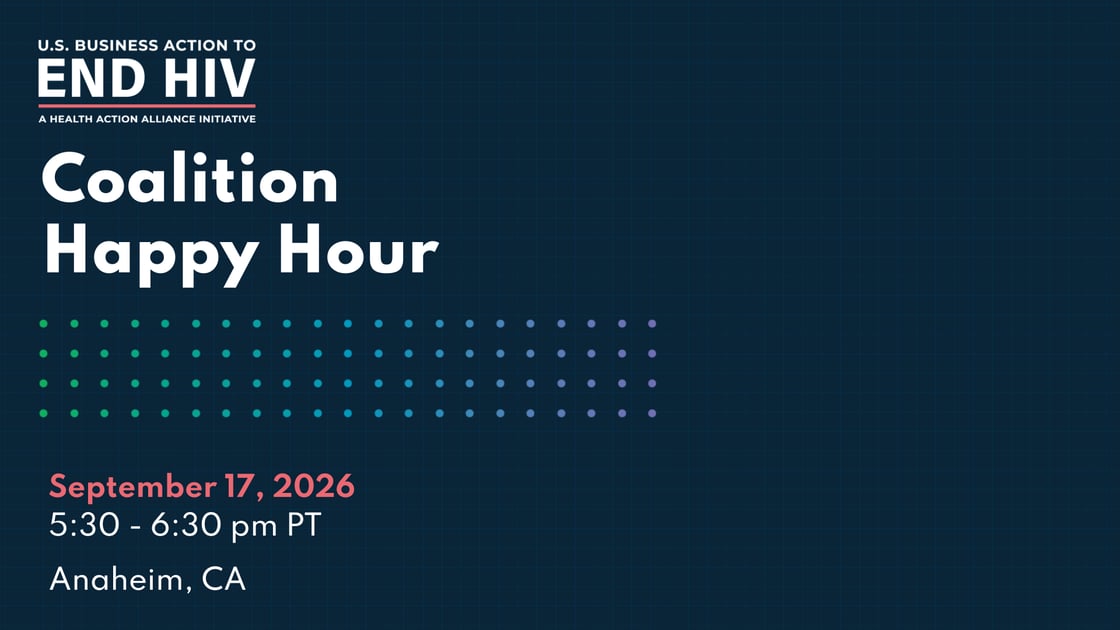
We are excited to host a happy hour at this year's U.S. Conference on HIV/AIDS (USCHA) in Anaheim, CA. We look forward to bringing together member companies, HIV Leadership Advisory Council members, federal and public health leaders, and friends to connect and network. Contact us at endhiv@healthaction.org for more information.
We will also be hosting a USCHA workshop, “Ready for Business? A Partnership Playbook for HIV Organizations” on Friday, Sept. 18, from 3:45 - 5:15pm PT in the Santa Monica Room on the Concourse Level/4th Floor. We hope you can join us!
.png)
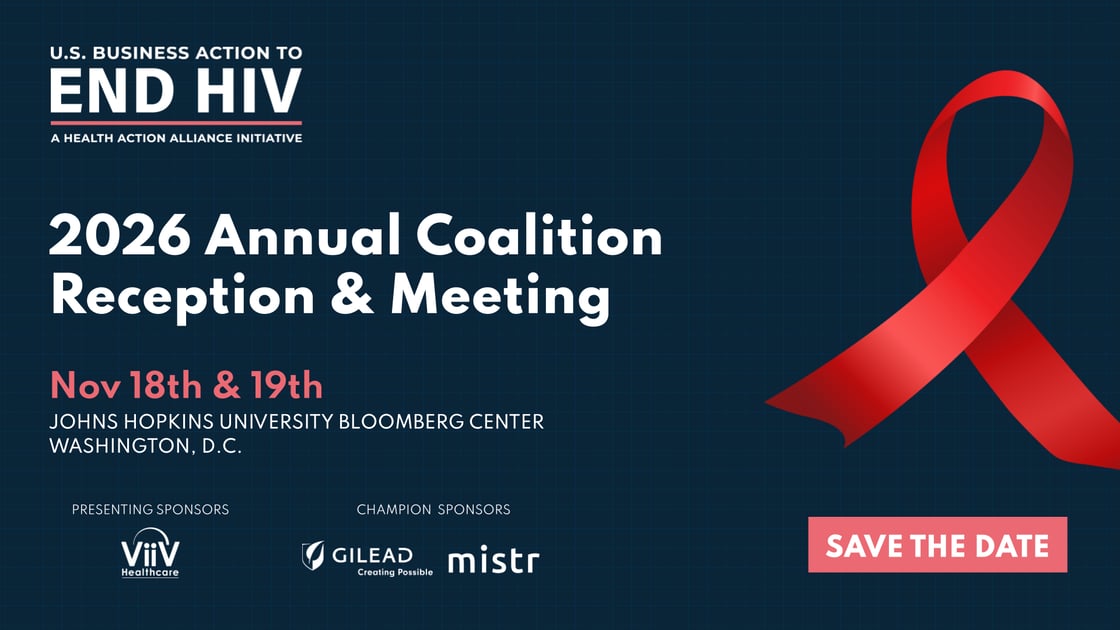
We are excited to host the 4th Annual U.S. Business Action to End HIV Coalition Convening this fall on November 18th & 19th in Washington, D.C. In partnership with the Johns Hopkins University Center for AIDS Research, this year's event will spotlight this pivotal moment in our nation's fight to end HIV and convene leaders from policy, public health, and business to help inform the strategies that will guide the movement's next chapter.
.png)
We are looking for leaders who can help inform business decisions about workplace culture, benefits, and policy. Share your expertise, shape industry trends, and get compensated for your valuable time. HR and benefits leaders, environmental health and safety professionals, corporate health and wellness professionals, people and culture leaders, and others are invited to participate.
.png)
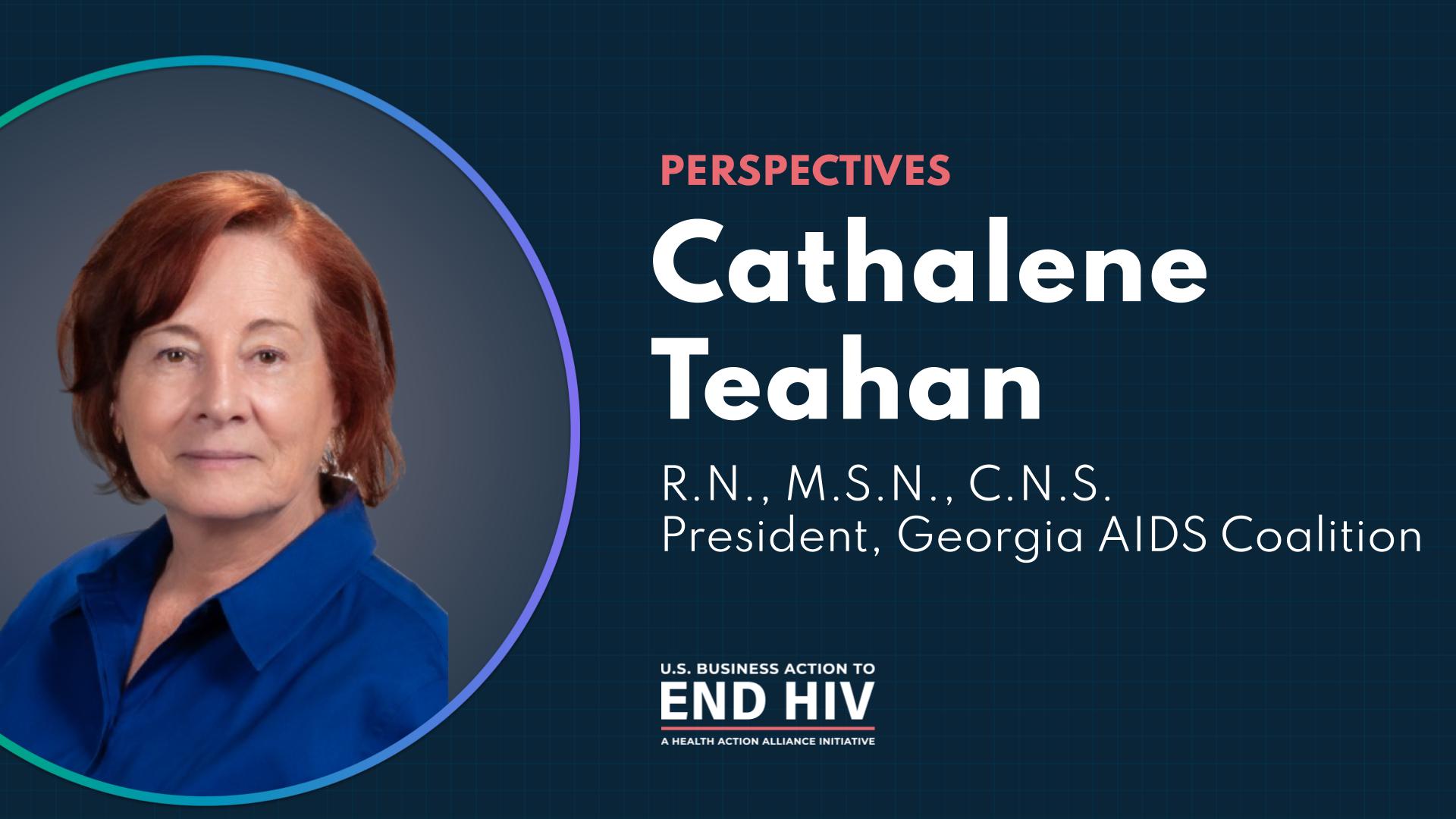
“Perspectives” is a series highlighting advisors, public health leaders, and advocates whose work informs systemic solutions, advances evidence-based policy, and drives meaningful health outcomes across communities.
This month, we spotlight Cathalene Teahan, R.N., M.S.N., C.N.S., President of the Georgia AIDS Coalition, Senior Public Affairs Consultant at Capitol Strategy, and HIV Leadership Advisory Council Member.
My dedication began at the very onset of the epidemic, long before we understood what the virus was or how it was transmitted. In those early years, intense fear gripped both impacted communities and the public — all too often, that fear turned into anger, stigma, and violence. As a nurse, my first responsibility was caring for those afflicted by the disease: providing compassionate frontline care, supporting families through unimaginable uncertainty, and replacing panic with accurate, evidence-based education.
Over the decades, research has radically transformed what is possible, giving us treatments to suppress the virus and powerful prevention tools while we continue the work toward a vaccine and a cure. What keeps me dedicated today is ensuring that the next generation understands this history, learns from how far we have come, and carries the momentum forward. We have come too far to ever give up.
We are at a decisive inflection point where ending the HIV epidemic is entirely within reach. While science has delivered the clinical tools needed to achieve viral suppression and halt transmission, medical breakthroughs alone cannot cross the finish line without systemic implementation.
This is where the role of business is critical. When business leaders engage, they bridge the gap between scientific capability and structural policy change. By deploying their corporate voice, resources, and civic standing, employers can dismantle access barriers and help drive the sustained political momentum required to end HIV for good.
Partner directly with organizations already doing the work on the ground in your community. Businesses can get involved in many tangible ways—whether by sponsoring or participating in local fundraisers, hosting community town halls, or lending corporate platforms to amplify public health education.
Just as importantly, businesses can align with groups leading policy and grassroots advocacy. By using your corporate voice to support initiatives that protect and expand access to testing, treatment, and prevention, companies can help break down structural barriers and ensure vital healthcare resources reach the people who need them most.
.png)
GLAAD's sixth annual State of HIV Stigma Report, produced with Gilead Sciences, finds that stigma remains a major barrier to HIV testing and treatment — with 44% of Americans still disputing the fact of Undetectable = Untransmittable and only 31% of Gen Z feeling knowledgeable about HIV. The report attributes this to an "invisibility paradox," where declining real-life HIV representation across TV, film, podcasts, and social media leaves room for misinformation to grow, compounded by rollbacks in federal funding and persistent state-level HIV criminalization laws. (GLAAD)
HIV treatment implementation, like transportation, clinic hours, stigma, and insurance shape whether patients test, start treatment, and stay engaged in care. Healthcare leaders should treat these operational barriers and support services (housing, transportation, food security) as core management metrics, since redesigning healthcare systems, not new medications, is the real next breakthrough against HIV. (Medpage Today)
Georgia's Board of Community Health voted to add HIV to its "medically frail" exemption list for Medicaid work requirements under Pathways to Coverage, reversing an earlier decision that had left HIV off the list and drawn criticism from advocates. Under the approved policy, HIV that has progressed to malignant cancer qualifies for automatic exemption, while general/asymptomatic HIV and HIV Type 2 are evaluated case-by-case — a notable change for Georgia, which has the nation's highest rate of new HIV infections (about 2,400 diagnoses in 2024). (Georgia Recorder)
A JAMA Internal Medicine study of over 8,400 Latino adults across the Bronx, Chicago, Miami, and San Diego found only 54% had ever been tested for HIV, despite Latinos accounting for 34% of new U.S. HIV diagnoses in 2024. Testing positivity was three times the national average overall and highest among sexual minority men, leading researchers to call for targeted communication strategies to reach less-assimilated Hispanic and Latino communities. (POZ)
Researchers have now documented over a dozen cases of HIV cure or treatment-free remission through several distinct pathways: stem cell transplants using CCR5-resistant donor cells, rare cases of natural "exceptional elite control," post-treatment control after stopping ART, and early pediatric treatment that shrinks the viral reservoir. While these cases remain rare, resource-intensive, or not yet fully understood, amfAR and other researchers see them as building blocks toward a scalable, widely available HIV cure. (amFAR)
Democratic attorney generals from 25 states and D.C. are suing to block a Trump administration rule requiring Medicaid expansion recipients to prove they're too sick to work rather than receiving blanket exemptions for serious diagnoses like cancer, arguing the policy is both too strict and too vague, leaving states to create inconsistent, burdensome verification systems. The case, being heard in Boston federal court, will determine how the 80-hour-per-month work requirement — set to take effect January 2027 with proof of medical frailty required starting in 2028 — is enforced. This foreshadows a larger political fight as some Republican-led states like Nebraska and Montana have already begun implementation. (Politico)
.png)
The Health Action Alliance is solely responsible for the content of this page and maintains full editorial control of its resources.
U.S. Business Action to End HIV was founded in 2022 by the Health Action Alliance, with support from ViiV Healthcare, to mobilize a growing coalition of private sector partners committed to filling gaps and accelerating progress to help end HIV in the U.S. by 2030.
The Health Action Alliance is a unique collaboration between leading business, communications, and public health organizations to help employers navigate evolving health challenges, improve the health of workers, and engage with public health partners to build stronger, healthier communities. Founded in 2021 by the Ad Council, Business Roundtable, CDC Foundation, the de Beaumont Foundation, and the Robert Wood Johnson Foundation, HAA's network now includes more than 11,000 employers nationwide, reaching a quarter of U.S. workers.

Sign up for our newsletter to keep updated on HAA’s latest initiatives, insights and recommendations, and be first to receive new resources and event invitations.
Sign up


.svg)


