


Toi Washington-Reynolds, Executive Director of the Trans Women of Color Healing Project, explains why closing the trust gap between corporations and communities is the next step in ending HIV in the U.S.
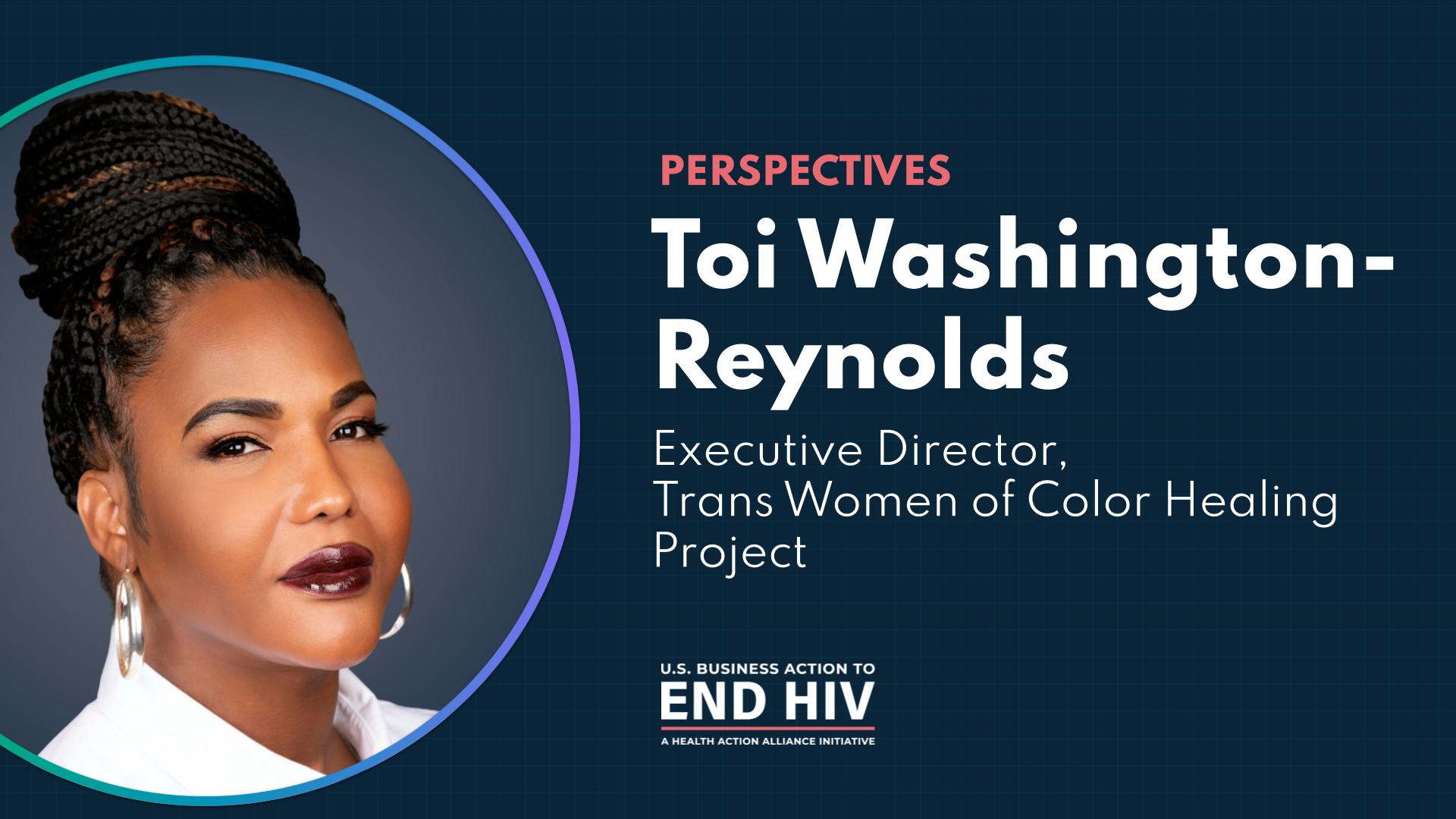


“Perspectives” is a series highlighting advisors who are leaders in the HIV field and provide guidance to U.S. Business Action to End HIV, ensuring that the Coalition's priorities are informed by the latest scientific research and best practices.
This month, we are pleased to spotlight Toi Washington-Reynolds, Member of our HIV Leadership Advisory Council and Executive Director of the Trans Women of Color Healing Project.
Toi Washington-Reynolds is a Global Health Equity Strategist, Trust Architecture Advisor, and Executive Director of the Trans Women of Color Healing Project (TWOCHP), a nationally recognized trans-led organization advancing culturally specific HIV prevention, restorative wellness, and survivor-centered care for marginalized communities across the South.
For more than a decade, her work has focused on strengthening retention in care, expanding access to PrEP, and rebuilding trust between underserved communities and healthcare systems through trauma-informed, whole-person approaches. She currently serves on the Leadership Advisory Council for U.S. Business Action to End HIV and Gilead Sciences' HIV Prevention Community Advisory Board, and has contributed community engagement strategies to PURPOSE 2 (Lenacapavir) as a Global Advisory Member.
Toi has presented at the International AIDS Society Conference in Munich, Gilead's CommUnity HIVision in Amsterdam, and was selected for the 2024 White House Black Women's Initiative Convening. Through all of it, her goal remains the same: building community-centered prevention systems that support people in building lives that thrive beyond HIV.
My dedication to this work is deeply personal. I've lost family, friends, and loved ones to the HIV epidemic, and those losses shaped my understanding not just of HIV, but of the pain and silence so many people carry every day. Over time, I came to understand that the greatest barrier is rarely medicine or access alone — more often, it's stigma. The fear of judgment, rejection, and shame has kept people from seeking care, disconnected them from support, and in many cases, cost them their lives.
What's also stayed with me is the power of intentional care and human connection. I believe love, dignity, and culturally affirming spaces can be real catalysts for healing. My commitment is to help create environments where people living with HIV are seen beyond their diagnosis — where their voices, experiences, and humanity are centered in the systems designed to serve them.
What makes this coalition powerful is its ability to bridge spaces that have historically operated separately. The opportunity before us isn't just about increasing investment — it's about eliminating the mistrust that often exists between corporations, healthcare systems, and the communities most impacted by HIV. I hope to see members move beyond traditional partnerships toward trust-centered collaboration that prioritizes genuine community engagement and long-term impact. Communities want to know they're not just being marketed to — they want to be seen, heard, and included in the solutions being built.
I believe this coalition can help build what I call an "Architecture of Trust" — systems and partnerships rooted in transparency, accountability, cultural understanding, and sustained commitment. When corporate influence, community wisdom, public health strategy, and lived experience are aligned, we can redefine what meaningful HIV prevention and care partnerships look like — and help create a future where fewer lives are lost to stigma and inequitable access to care.
What feels different about this moment is that communities are realizing we can no longer afford to operate in silos or rely on systems that have repeatedly failed us. This moment requires more honesty, more collaboration, and more intentional trust-building — between communities, organizations, institutions, and businesses. We have to be willing to dismantle systems that have caused harm while building new ones rooted in dignity, accountability, and shared responsibility.
That's where the role of business becomes critically important. Businesses have influence, resources, and the ability to help shape culture at scale. But communities want more than visibility campaigns. They want to know corporations are genuinely invested in their lives and futures. That means listening to lived experience, investing in community-rooted leadership, and creating long-term partnerships that don't evaporate after a moment of public pressure. Transgender people are leaders, innovators, caregivers, and contributors to science, culture, public health, and social progress — and we deserve to be treated as partners in building the future, not as political talking points.
Show up intentionally. If your company can donate financially, that support makes a direct impact on organizations doing frontline work every day. If that's not possible, there are still powerful ways to contribute: donate time, expertise, volunteers, or platforms. Lend your voice. Share your networks and audiences with community-based organizations already trusted by the people most impacted.
This year, TWOCHP is a beneficiary organization for AIDS Walk Atlanta — donations made to us will be matched through AHF, giving businesses a direct way to strengthen community-rooted HIV prevention and support services. But beyond any single opportunity, what matters most is consistency. When companies invest in Black and Brown transgender and gender-diverse communities not just during awareness moments, but all year long, it sends a clear message: your lives are a priority, not an afterthought.
While we spend so much time trying to make the world around us better, we must also remain committed to becoming better ourselves. In this work, we are constantly responding to crises, advocating for others, and carrying the weight of communities depending on us. But leadership also requires moments of self-reflection, healing, and growth — not just improving systems and outcomes, but making sure we are evolving into healthier, more grounded, more intentional leaders.
Lead with grace. We give grace because we hope to receive it in return — and because someone, at some point, extended it to us. In moments like these, when the work is heavy and the world feels uncertain, grace and intentional care matter just as much as strategy and innovation. That's how we sustain the work, and how we sustain each other.

U.S. Business Action to End HIV was founded in 2022 by the Health Action Alliance, with support from ViiV Healthcare, to mobilize the private sector to help end HIV in the U.S. We offer free tools, resources, and events to help employers educate workers, fight stigma, improve access to HIV prevention and treatment services, and build connections to the communities that need it most.
Join the Coalition today.
Sign up for our newsletter to keep updated on HAA’s latest initiatives, insights and recommendations, and be first to receive new resources and event invitations.
Sign up


.svg)


