


Newsletter from U.S. Business Action to End HIV, providing the latest actions from the coalition, together with other important news.
.png)


Editorial Note: You can stay informed and receive our monthly Action Report newsletter directly to your inbox by joining the mailing list.
As we close out 2025, we want to express our heartfelt appreciation for your unwavering commitment and the meaningful actions that have defined the Coalition's impact this year.
We're incredibly proud of everything we've accomplished together over the past three years. The dedication, innovation, and collaboration you bring to this work are extraordinary — and we're only growing stronger as we look ahead to 2026.
Wishing you a restful and rejuvenating end of the year. Happy holidays!
Welcome New Member:


Several member companies honored World AIDS Day this year with special activations, employee events, articles, and social media posts to raise visibility. Here are some highlights:
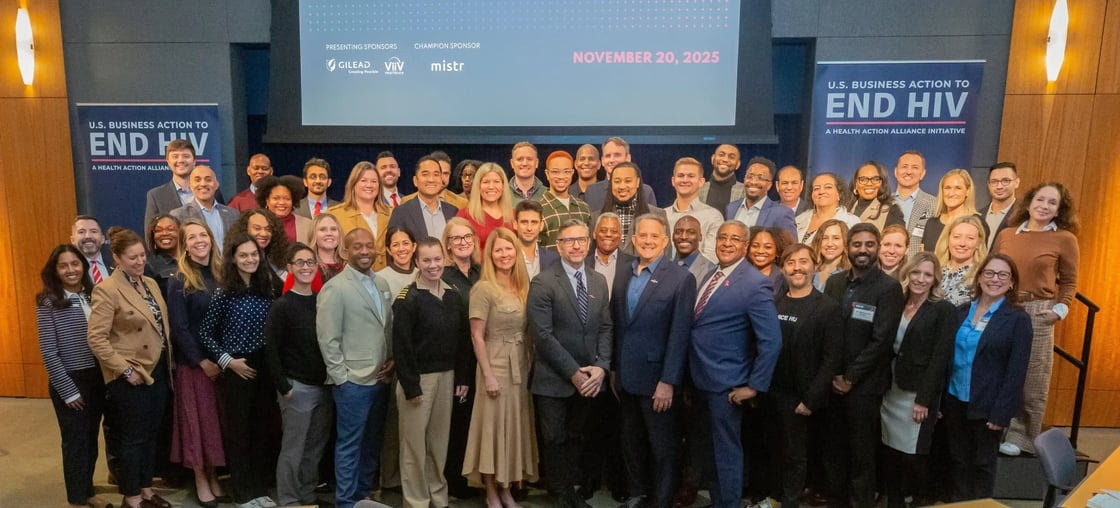
AP News featured U.S. Business Action to End HIV, highlighting how 95 companies are playing a growing role in the push to end HIV by 2030 through expanded testing, prevention, and workplace initiatives. The article points to concrete results, from nationwide free testing to rapid PrEP uptake, as evidence that business-led action is translating into real-world impact.
.png)
We are proud to share two new resources, produced in collaboration with GLAAD and first introduced at our Oct. 8 meeting with media and entertainment industry leaders, focused on the power that storytelling has to shift HIV narratives. These resources are designed to offer steps to reshape storylines on screen and support creative professionals behind the scenes:
.png)
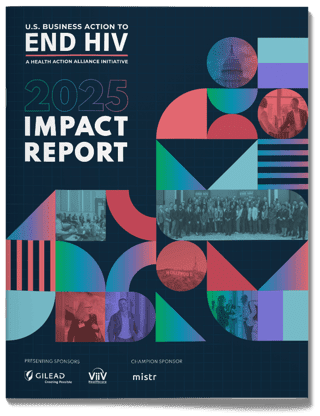
Our annual report offers a snapshot of how business leaders expanded access to HIV prevention and care, dismantled stigma, and strengthened their communities in 2025.
Here's what's inside:
📈 Impact at a glance: Key milestones, including member growth and engagement.
✅ Company commitments: Member action pledges across six areas of impact.
🏛️ Industry cohort highlights: Our progress on policy, testing, and culture.
🌆 Local action: How our regional chapters mobilized their communities.
💡 Company action spotlights: How leading employers took action to help end HIV.
🏆 Recognition and reach: Awards and media coverage recognizing our work.
.png)
The Trump administration has directed the State Department and its grantees not to use government funds or public communication channels to commemorate World AIDS Day, framing the move as part of a broader strategy to modernize infectious disease efforts. Critics warn that this decision, alongside cuts to U.S. HIV programs, could worsen the global epidemic and recalls the early neglect of HIV as a public health crisis. (NYT)
A man has become the seventh person cured of HIV after a stem cell transplant for blood cancer. Notably, using donor cells that were not fully resistant to the virus shows that HIV-resistant stem cells may not be essential for a cure. This case, along with the earlier "Geneva patient," suggests that carefully matched donor cells can eliminate the patient's remaining infected immune cells, expanding potential options for stem cell–based HIV cures. (NewScientist)
Birmingham artist Carlton V. Bell II uses his work to spotlight marginalized communities, warning that people living with HIV are being increasingly abandoned amid government cuts and rising stigma. As a Black queer creative living with HIV, he sees harmful rhetoric and anti-LGBTQ+ policies deepening isolation and blocking access to care. (AL.com)
The military asked the Fourth Circuit to reinstate its ban on enlisting people with HIV, arguing that medical needs, deployment limits, and costs justify excluding even those who are asymptomatic and undetectable. Plaintiffs and advocacy groups counter that the policy is outdated, discriminatory, and inconsistent with medical evidence and the court's own prior rulings. (Courthouse News Service)
New York City saw a 5.4% rise in HIV diagnoses in 2024, continuing a multi-year trend. The increase disproportionately affects Black and Latino residents in high-poverty areas, highlighting persistent racial, socioeconomic, and structural barriers to care. (Gothamist)
A mid-year budget cut by Pennsylvania's Department of Health could force regional HIV service providers to reduce support for housing, prescriptions, and other essential services, putting nearly 100 people with HIV at risk of homelessness in South Central Pennsylvania. Officials cite rising medication costs and program enrollment as reasons, warning that the cuts could worsen health outcomes and hinder efforts to combat HIV despite high rates of timely care in the state. (Witf)
.png)
The Health Action Alliance is solely responsible for the content of this page and maintains full editorial control of its resources.
U.S. Business Action to End HIV was founded in 2022 by the Health Action Alliance, with support from ViiV Healthcare, to mobilize a growing coalition of private sector partners committed to filling gaps and accelerating progress to help end HIV in the U.S. by 2030.
The Health Action Alliance is a unique collaboration between leading business, communications, and public health organizations to help employers navigate evolving health challenges, improve the health of workers, and engage with public health partners to build stronger, healthier communities. Founded in 2021 by the Ad Council, Business Roundtable, CDC Foundation, the de Beaumont Foundation, and the Robert Wood Johnson Foundation, HAA's network now includes more than 11,000 employers nationwide, reaching a quarter of U.S. workers.

Sign up for our newsletter to keep updated on HAA’s latest initiatives, insights and recommendations, and be first to receive new resources and event invitations.
Sign up


.svg)


