


The Hollywood + HIV Collective’s new co-chairs explain how a single character, a coworker on PrEP or a couple getting tested together, can help shift how people think about HIV.


U.S. Business Action to End HIV's Hollywood + HIV Collective works with entertainment companies and storytellers to bring modern, authentic portrayals of HIV to the screen, and to support the people behind the camera doing that work.
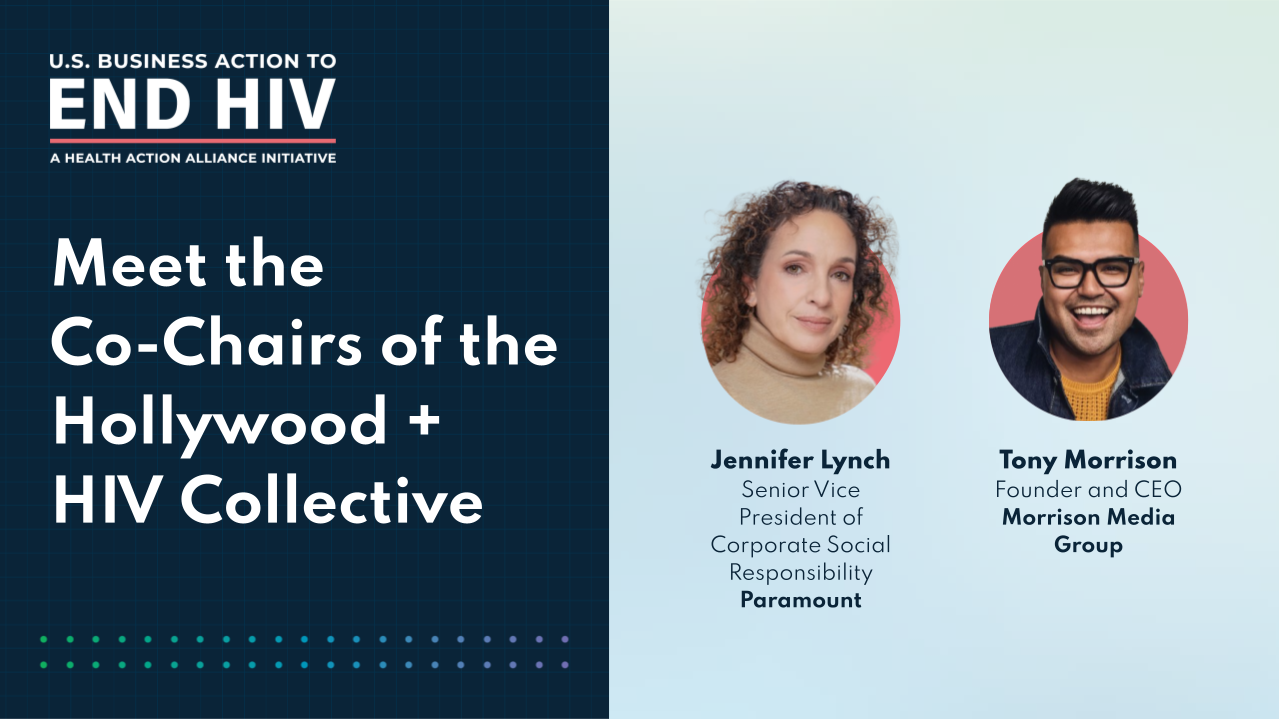
This month, we're introducing two people helping lead that work, collective co-chairs Jennifer Lynch, Senior Vice President of Corporate Social Responsibility at Paramount, and Tony Morrison, Founder and CEO at Morrison Media Group.
Jennifer brings a studio's perspective of what it takes to effectively champion this cause from a corporate perspective, and how workplace policy and on-screen content can reinforce each other.
Tony brings both a journalist's instinct for storytelling and firsthand experience: he's spent nearly two decades in entertainment media, including at ABC News and GLAAD, and has spoken publicly about living with HIV himself.
Together, they know how stories get made, and what makes a story worth telling in the first place. We asked Jennifer and Tony to share more about their vision for the Collective and where they see the biggest opportunities ahead.
Jennifer: HIV has been a social issue for me from the moment I started thinking about how I was going to live a life of meaning. While bartending at a gay bar in New York’s West Chelsea while getting my master’s in public service back in the 90’s, it felt like each week we were losing more customers, more friends. It was devastating.
Now, here we are, decades later without a cure while nearly 41M people are living with HIV globally. And while the disease is no longer a death sentence, here in the US, 1 out of 8 people are living with HIV and do not know they have it. Why don’t they know? Are they afraid to get tested? Are they ashamed of the stigma?
That’s where Hollywood comes in – because storytelling matters. Representation delivers results. In the stories seen on your screens, a character with HIV can help normalize prevention and treatment and lessen social shame. And I think that is where the Hollywood + HIV Collective comes in. As a community, we can encourage more authentic portrayals of HIV on screen, and we can amplify those we are seeing.
Tony: This Collective has the power to save lives. We're coming together to, yes, rewrite the script for how HIV is told in today's world, but we have a blank canvas. That's what excites me most. We aren't here simply to update old narratives. We have an opportunity to create entirely new ones.
My hope is that we can convene mainstream conversations around modern and respectful HIV storytelling by including our voices where people living with HIV already exist: in every sector of society, every demographic, and every kind of story.
Including our voices in conversations around modern medicine, health, wellness, longevity, love, family, and ambition is paramount. HIV doesn't exist in a vacuum, and neither should the stories we tell about it.
Ultimately, I don’t think the success for this Collective will be measured by how many HIV stories get made. It'll be measured by how naturally people living with HIV begin showing up across entertainment, because that's what real life already looks like, and a true reflection of the world we live and do business in.
Jennifer: I have never been more hopeful for HIV storytelling than I am right now. Across mediums, from film to television and beyond, we’re seeing a lot of conversation about nuanced portrayals of life with HIV that keeps it at the forefront of the public’s consciousness and fosters empathy for— and greater understanding of—this cause. The hope is that all of these stories will spark new conversations about HIV and AIDS for new generations – which I feel we desperately need right now as, on average, 3,500 new HIV diagnoses are being recorded each day.
Tony: Modern HIV storytelling can still honor its horrific past and the countless lives lost without compromising the reflection of who we are today. Those stories deserve to be remembered, but they shouldn't be the only stories audiences see.
Science has transformed what it means to live with HIV. It’s culture that has some catching up to do.
Today's stories that include HIV must make room for joy, romance, careers, friendship, parenthood, aging, success, wellness, and longevity, not because we're ignoring history, but because we're finally telling the whole story.
To this day, I've not felt represented in any HIV storyline I’ve seen in mainstream media.
As someone living with HIV, it’s why I'm so excited to help lead this Collective. Give me an on-screen mainstream character living with HIV whose story isn't rooted in rejection or sorrow, but freedom, accomplishment, love, humor, purpose, and a community that supports them.
There is enough story to go around, and the opportunity ahead of us is infinite because HIV isn't a genre, it's simply one part of millions of people's lives. That's the kind of representation I want audiences to see.
Paramount was the home of the very first LA AIDS Walk back in 1985. The goal was to raise $100,000 and donations ended up coming in at 7x that amount. Paramount has remained the only corporation that has consistently supported the LA AIDS Walk year after year for the past 40+ years. Our employees take that commitment very seriously as I find that more and more of our employees – from senior leaders to support staff, gay and straight, share how they have been touched by the AIDS epidemic. They walk the walk, literally, but also fundraise, advocate and volunteer with nonprofit partners like APAIT, Project Angel Food, and Reach LA, to name a few.
When amfAR recognized our Paramount Fights HIV/AIDS initiative with their philanthropic leadership award, it was for the body of work of all our employees who are committed to HIV/AIDS awareness and advocacy.
Jennifer: One of the goals of the Hollywood + HIV Collective is to ensure people living with HIV are portrayed in film and television and portrayed accurately. We are striving for subtle inclusions of HIV storylines that keep the conversation going. Earlier you asked me why does this matter so much now. It matters because this year we lost the actress Daveigh Chase, from our film “The Ring” to AIDS. And she was just one of more than 1,500 people who die from AIDS-related illness each day worldwide.
Hollywood, with its on-screen depictions, helped normalize the seat belt, the designated driver, and can do the same with HIV prevention. To screenwriters, I would say: make the neighbor HIV positive; show the co-worker taking PrEP before a post-work happy hour, have a young couple take an HIV test before moving in together. None of these elements will change your story, but they could change a life.
Tony: I want creatives and executive leaders to lead their innovation with curiosity and with inclusion. And I want them to remember that telling new stories is not equal to taking a business risk.
This includes bringing people living with HIV into the room early, listening before writing, and challenging the assumptions inherited about what society has whispered about people like me.
Audiences aren’t just ready for these kinds of stories, they are demanding them. It's time we equip our sectors and industries to catch up.
Culture-driven marketing begins with understanding every dimension of your audience, not simply trying to capture their attention. Why should culture-driven storytelling be any different?

U.S. Business Action to End HIV was founded in 2022 by the Health Action Alliance, with support from ViiV Healthcare, to mobilize the private sector to help end HIV in the U.S. We offer free tools, resources, and events to help employers educate workers, fight stigma, improve access to HIV prevention and treatment services, and build connections to the communities that need it most.
Join the Coalition today.
Sign up for our newsletter to keep updated on HAA’s latest initiatives, insights and recommendations, and be first to receive new resources and event invitations.
Sign up


